Beginner field guide

Where Winds Meet Stats Explained: Affinity & Agility

A field guide for reading the character sheet before you copy a build. It starts with the search questions players are actually asking: what Affinity Rate does, why Momentum raises it, what Agility changes, and why this guide does not invent a universal conversion ratio.

Combat statsAttributesCritical and AffinityBuild reading

Maintained byHeavenskiss

Pinned answer

Affinity Rate comes from Momentum, not Agility.

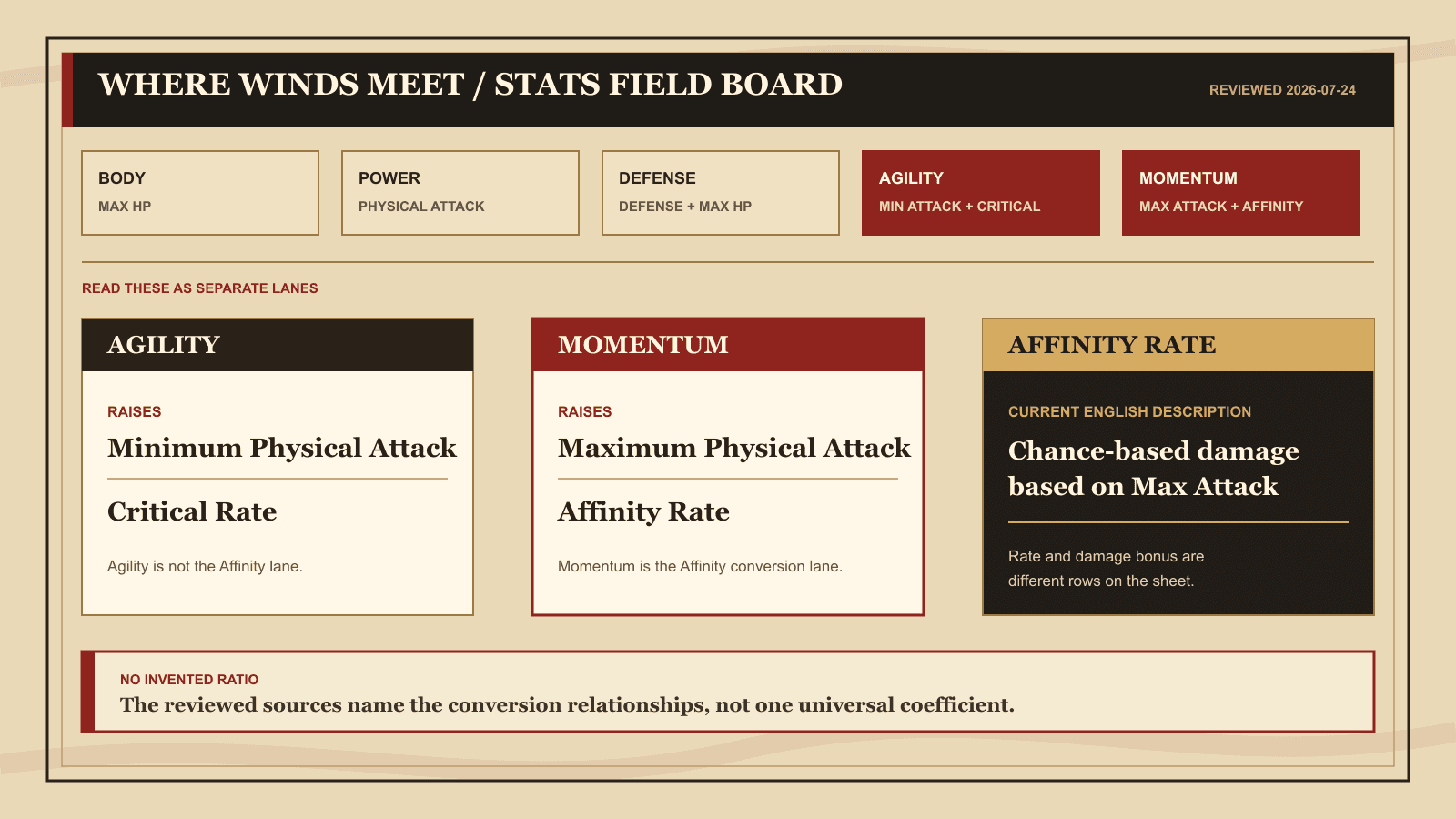
The current English stat reference describes Affinity Rate as the chance to trigger increased damage based on Max Attack. Momentum raises Affinity Rate and Maximum Physical Attack; Agility raises Critical Rate and Minimum Physical Attack. The reviewed references name those conversion relationships but do not establish one universal points-to-percent coefficient, so this guide does not publish an invented ratio.

Survival base

Body = Max HP; Defense = Physical Defense + Max HP

Agility lane

Minimum Physical Attack + Critical Rate

Momentum lane

Maximum Physical Attack + Affinity Rate

Do not mix panel types. Combat Attributes affect fighting; Exploration Attributes such as Resolve, Perception, Coordination, and Intelligence support exploration skills and checks; Career Attributes support professions such as Healer or Scholar; Character, Gear, Mystic Skills, Inner Ways, and Martial Arts Development are progress indexes, not direct stat-priority instructions.

Original Winds Meet Guide board comparing Agility, Momentum, Critical Rate, and Affinity Rate
Original Winds Meet Guide reference board. It diagrams the reviewed English stat relationships and deliberately omits an unverified universal conversion coefficient.

Action plan

Read a stat sheet in six passes instead of chasing the largest number.

  1. 1

    Identify which attribute panel you opened

    Combat, Exploration, Career, and Development pages answer different questions. A high Exploration attribute will not directly repair a combat damage problem, and a high Gear Development score does not tell you whether the equipped affixes suit your weapon or role.

  2. 2

    Read the five base combat attributes

    Body supports Max HP; Power supports Physical Attack; Defense supports Physical Defense and Max HP; Agility supports Critical Rate and Minimum Physical Attack; Momentum supports Affinity Rate and Maximum Physical Attack. Use these as links to the detailed rows below them, not as a ranking by themselves.

  3. 3

    Check survival before damage

    Read Max HP, Max Qi, Physical Defense, and the relevant resistance or damage-reduction rows. When Qi reaches zero, the character becomes Exhausted. If a build repeatedly dies or loses Qi control, another offensive roll may not solve its actual failure.

  4. 4

    Read the Physical Attack range

    Minimum and Maximum Physical Attack describe the lower and upper ends of the attack range. Agility pushes the minimum side; Momentum pushes the maximum side; Power raises Physical Attack generally. A larger ceiling can coexist with inconsistent low rolls.

  5. 5

    Keep Precision, Critical, and Affinity separate

    Precision Rate, Critical Rate, and Affinity Rate are separate rows with different tooltip language. Critical is linked to Agility and can increase damage or healing; the current English stat reference describes Affinity as a chance to increase damage based on Max Attack and links its conversion to Momentum. Read each live tooltip before comparing a rate bonus with a damage-bonus roll.

  6. 6

    Judge affixes only inside a real build

    Attribute Attack, healing, penetration, resistance, Critical DMG Bonus, and Affinity DMG Bonus matter only when the weapon, damage type, role, and mode can use them. Define the build and its current failure first, then tune or replace gear. A generic stat-priority list cannot see your breakpoints or dead affixes.

Decision table

Use the symptom to choose which rows deserve attention.

You die too quickly

Compare Max HP, Physical Defense, relevant resistance, and Qi management before adding more offense.

Body and Defense support survival, but damage type, failed defensive actions, and Exhausted states can be the real cause.

Damage feels inconsistent

Inspect Minimum and Maximum Physical Attack together, then compare Agility and Momentum.

Agility supports the attack floor while Momentum supports the ceiling, so the same headline maximum can hide a wide range.

You want Critical

Read Agility, Critical Rate, and Critical DMG Bonus as three related but distinct rows.

Chance and bonus damage are not interchangeable; increasing the payoff of an event that rarely occurs may not fix consistency.

You want Affinity

Read Momentum, Affinity Rate, Maximum Physical Attack, and Affinity DMG Bonus together.

Affinity is tied to Momentum and the maximum-attack side, so one isolated percentage does not describe the whole result.

Attacks underperform on a boss

Check Physical or Attribute penetration against the matching resistance before blaming base Power.

Attack, penetration, enemy resistance, and damage modifiers are different parts of the result; a higher sheet attack can still meet mitigation.

Healing is the goal

Inspect Attribute Healing and healing-specific bonus rows, then verify that the active skill scales from them.

A damage-oriented affix can be a dead roll for a healer even when it raises a visible development score.

Exploration check fails

Open Exploration Attributes and the related exploration skill instead of changing combat gear blindly.

Resolve, Elegance, Perception, Coordination, Intelligence, and the other exploration lanes belong to a separate system.

Development score is high

Open the Character, Gear, Mystic Skills, Inner Ways, and Martial Arts details and inspect what was actually upgraded.

Development is an index of progress. It can reveal an underdeveloped system, but it does not prove the current stat mix is effective.

Problem fixes

Six stat-sheet mistakes that lead to expensive gear decisions.

A guide gives one best stat for every build

Treat it as incomplete until it names the weapon pair, role, mode, gear state, and tested formula. The base relationships are stable enough to read the panel, but a priority depends on what the build already has and what problem it needs to solve.

My Development went up but combat feels the same

Find which Development category increased. A larger index can come from a system upgrade without improving the action, damage type, survivability issue, or rotation that matters in this fight. Compare the underlying combat rows and test the same encounter.

I cannot tell Critical from Affinity

Critical is linked to Agility; Affinity is linked to Momentum and the maximum-attack side. Keep Critical Rate, Affinity Rate, Critical DMG Bonus, and Affinity DMG Bonus as separate rows. The live tooltip and your active weapon effects should decide which event the build actually supports.

I found an Agility conversion number

Check whether it names the patch, level, mode, and exact stat row. The reviewed English references confirm that Agility affects Critical Rate and Minimum Physical Attack, but they do not establish one universal points-to-percent coefficient. This page will not turn an uncited ratio into a rule.

My Qi reaches zero

Zero Qi causes Exhausted. Review defensive timing, Qi damage taken, Max Qi, and the encounter pattern before rerolling an offensive affix. A stat sheet cannot compensate for repeatedly entering the same punish window.

I am about to spend tuning materials

Write down the current problem, the exact row you expect to improve, and the weapon or role that uses it. If you cannot connect the new affix to those three things, keep the material until the build direction is clear.

Five bases

Body, Power, Defense, Agility, Momentum

They feed documented combat rows; they are not five independent build scores.

Agility

Critical + attack floor

Agility supports Minimum Physical Attack and is linked to Critical Rate.

Momentum

Affinity + attack ceiling

Momentum supports Maximum Physical Attack and is linked to Affinity Rate.

No universal list

Problem before priority

Choose a stat only after naming the build, mode, current sheet, and failure to fix.

Sources and questions

Where the current rules came from, plus the next useful route.

What is Affinity Rate in Where Winds Meet?

The current English stat reference describes Affinity Rate as the chance to trigger increased damage based on Max Attack. It is linked to Momentum. Affinity Rate and Affinity DMG Bonus are separate rows, so increasing the chance is not the same as increasing the bonus applied when Affinity triggers.

Does Agility increase Affinity Rate?

No according to the reviewed current English attribute mapping. Agility affects Critical Rate and Minimum Physical Attack. Momentum affects Affinity Rate and Maximum Physical Attack.

What is the Agility conversion ratio?

The reviewed sources name Agility Conversion for Critical Rate and link Agility to Minimum Physical Attack, but they do not establish one universal points-to-percent ratio. Check the live character-sheet tooltip and record the before-and-after values for your current level and mode instead of relying on an uncited fixed number.

What are the five base attributes in Where Winds Meet?

They are Body, Power, Defense, Agility, and Momentum. Body raises Max HP; Power raises Physical Attack; Defense raises Physical Defense and Max HP; Agility raises Critical Rate and Minimum Physical Attack; Momentum raises Affinity Rate and Maximum Physical Attack.

What is the difference between Critical and Affinity?

Critical is linked to Agility, while Affinity is linked to Momentum and the maximum-attack side of the sheet. Their rates and damage bonuses are separate rows, so compare the full set of relevant stats and the active weapon effects.

What happens when Qi reaches zero?

The character becomes Exhausted. Review defensive timing, Qi damage, and Max Qi rather than assuming more Physical Attack will solve the encounter.

Are Exploration Attributes combat stats?

No. Exploration Attributes such as Resolve, Perception, Coordination, and Intelligence support exploration skills and checks. Career Attributes support professions, while Combat Attributes affect fighting.

What is the best stat in Where Winds Meet?

There is no responsible universal answer. The best next stat depends on weapon pair, role, mode, current values, affixes, enemy mitigation, and the specific problem you are fixing. Use the five base relationships to diagnose the sheet before following a priority list.